Given the topic of this post, I want to tip my hat to an article from Dr. Michael Wagner in the Western Standard at the outset of this post.
One more word before I start. My intent is to demonstrate that Christianity really and truly is good for the world. Secularism is a truly bleak worldview. Secularism is divisive. A house that is built on a divided foundation, cannot stand. Secularism will collapse under its own internal contradictions.
Secularism will collapse under its own internal contradictions.
To paraphrase a good friend here in Alberta: “Give me Christianity, or give me death! Your bleak promises are not worth living for.”
Sovereignty, Separatism and Revolutionaries
My central thesis with regards to sovereignty is that absolute sovereignty resides in God. God delegates authority to men as His image bearers who are called to dominion in service to Him. He delegates authority to men in their various spheres, whether that be civil government, ecclesiastical government, familial government, or self-governance.
You can find this in the Reformed confessions, in historic Christendom, in the writings of Abraham Kuyper and Groen Van Prinsterer. You can find it in the Reformers. No idols allowed. Not the state. Not the individual. We worship the Triune God who has revealed Himself in Jesus Christ.
We worship the Triune God who has revealed Himself in Jesus Christ.
Most importantly, you can find this right in the Bible. If you simply consider the very language of Romans 13, it describes authorities as ministers of God. You can also find this in Psalm 2 and other passages of Scripture where governments (whether family, ecclesiastical, civil or self) are called to give up their rebellions and find their life in Christ. You to, rebel rulers of the earth, must turn from your sins and find your life in Jesus Christ, the Lamb of God, who takes away the sins of the world.
Is Sovereignty Located in the Individual?
You can imagine then that it struck me as jarring when I saw a letter from the Alberta Prosperity Project. It located sovereignty in the individual (very similar to the French revolution). I’ll post the entire letter as an addendum, but I’ll start with responding to a few quotes.
At its core, sovereignty is not granted by a state. It’s recognized. It doesn’t flow downward from force—it rises up from people. People are born sovereign. And Albertans have had this whisper calling them back to sovereignty, their independence, for decades.
I’ll continue.
Like the air we breathe, Natural Law is constant. Whether we can see it or not. Sovereignty is. (That’s a complete sentence.)
And again.
Sovereignty is not a government’s job. It’s ours. Governments, by nature, gather power and protect it with implied force. This isn’t right or wrong, it’s just how the system’s set-up. But it’s a flawed design in opposition to Natural Law, and because of that governments are temporary. Sovereignty isn’t.
This is problematic. Here is why. I will start by arguing from a different direction.
The Sovereignty of God
God is. (That’s a complete sentence). He is the absolute sovereign. He has given a natural order, including rights and duties. He has delegated authority, distributing it in various spheres of authority.
This is the foundation for the constitutional order for many western republics up until it started to break down with the French Revolution in the late 1700s and then Nazi Germany in the early 1900s. Contra the French Revolution – rights are not granted by the individual, they are granted by God. Contra the revolution of the Third Reich – rights are not granted by the state “sovereign”, but by God, the true sovereign. Groen Van Prinsterer writes an entire book against the French Revolutionary ideal entitled Unbelief and Revolution. You can find it here.
So what is going on with this location of sovereignty in the individual?
I don’t deny the category of self-government. The image of God is located individual men and women. God has called men to wield right dominion in service to Him. Individuals who become pastors and MLAs and MPs and fathers. They do so as members of their communities. It is self-governed men who eventually govern others whether that be in the home, state, church…
The Alberta Prosperity Project is onto something true, good, and beautiful. It’s called self-government (I’ll talk about ascetism in a moment). This is one of the spheres of human government. But the fact that they stop there and then exalt the individual, by locating sovereignty in the individual, makes it ugly and rancid.
It is pure humanism. Humanism is an anthropocentric worldview that prioritizes human values, self-sufficiency, and secular ethics over God’s sovereignty and the truth of Scripture.
Natural Law
I accept natural law as a proper category. But natural law on its own, or determined by the individual can be a very subjective category. My Church and many others accept this definition of natural law in the Belgic Confession of Faith. It is important not to assume definitions, but to establish them with due clarity.
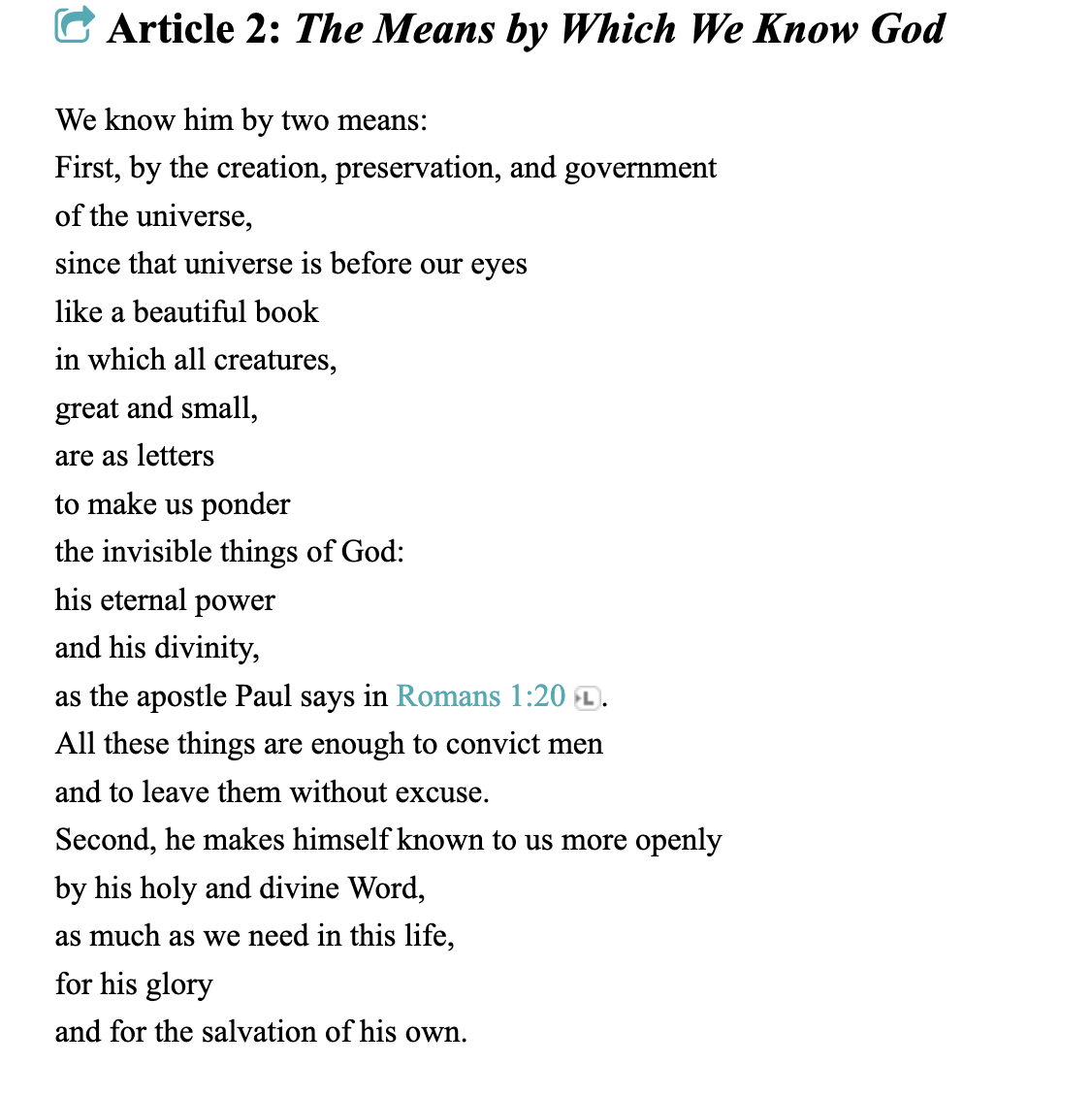
Natural law demands a recognition of God as the absolute sovereign. So when the APP talks about Natural Law and then goes on to ground sovereignty in the individual rather than God, this is a denial of Natural Law itself. One reformed theologian spoke about this natural law principle as the sensus divinitatis or “the sense of the divine.”
We especially need the Bible to show who the sovereign God is. Natural law as it led to the proper rule of nations early on, always needed the enlightenment of the Word of God, by which He makes Himself known to us even more openly.
Wisdom cries out in Parliament Hill and in the Alberta legistlature in Proverbs 8:15–16: “By me kings reign, and rulers decree what is just; by me princes rule, and nobles, all who govern justly.”
Sphere Sovereignty, Subsidiarity, Ascetism
I recognize that there are many frameworks for how to talk about how societies govern themselves. There is liberty to debate these frameworks within Christendom, albeit on the premise that God is the absolute sovereign.
A doctrine of civil authority must also be predicated on gospel proclamation and that societies believe the gospel. This will produce gospel fruit. These gospel fruits are good for the world. We should not be embarrassed of the gospel. We should also not be embarrassed of the reality that the gospel produces fruit. After all, we must teach the nations all things that Christ has commanded (Matt. 28:16-20).
In the past I have talked about sphere sovereignty, subsidiarity and ascetism. I think it is a helpful framework for a Christian view of government. Here is how I define each.
Sphere sovereignty is the belief that God is the absolute sovereign and delegates authority within their spheres. This does not mean that we look at the spheres of authority (church, state, family, individual) on an egalitarian playing field, flattening all distinctions and not seeing any hierarchy in God’s order. It simply means that God delegates differing spheres with differing authorities. It is a meta-philosophy which has to be worked out in the minutiae.
Subsidiarity is the belief that local government is the most important form of government, and that there are times when the lesser magistrate needs to stand up to the higher magistrate. Decision-making and responsibilities should be handled at the most local or immediate level possible, rather than by a centralized authority. People will talk about a Roman Catholic doctrine of subsidiarity, but there are Reformed and Presbyterian forms of this as well. Ie. Abraham Kuyper.
I define ascetism especially as self-discipline. It is men who rule themselves well, they have dominion over their minds and their bodies, who should be given rule within society, whether that be by a woman to a man in marriage or by a church to a pastor or by a community to a mayor or a premier.
All of these concepts should be established within a covenantal framework, understanding that the most important bond within society is between man and God.
The only totalizing principle for society is obedience to God. Christ makes this possible through union with His death & resurrection, through the gift of His atonement for the sins of men. This is the path of radical discipleship to Jesus Christ.
Civil authority or Indidividual authority?
I’m not proposing a full-orbed philosophical system here. I’ll leave that to the political philosophers & theorists, even as I offer sometimes intense theological push-back.
As I study the Bible and historic Christian theology, I am increasingly convinced that there are ways in which the individual keeps the civil authority in check and the civil authority keeps the individual in check. All those checks and balances should happen in obedience to God. That is, the one true God who has revealed Himself in the Holy Bible.
But what is axiomatic is that God is the absolute sovereign.
This means that the individual must bow the knee to God and His enthroned Son Jesus Christ. The civil authority must also bow the knee to God and His enthroned Son Jesus Christ.
A final word from Psalm 2:10–12
[10] Now therefore, O kings, be wise;
be warned, O rulers of the earth.
[11] Serve the LORD with fear,
and rejoice with trembling.
[12] Kiss the Son,
lest he be angry, and you perish in the way,
for his wrath is quickly kindled.
Blessed are all who take refuge in him.
Below is the letter from the Alberta Prosperity Project:
Governments Come and Go. Sovereignty Stands.
Governments are temporary. Parties rise and fall. Leaders change, policies shift, bureaucracies swell and shrink with the times.
That’s the character of politics: it’s temporary by design. Or at least it should be.
After a decade of Liberal rule, the government has become bloated, there’s a new tax every time we blink, traditional – and legal – democratic processes are steam-rolled and the pattern is only accelerating.
But a fresh movement is rising in Alberta. It relies on an old idea. One based in nature.
Sovereignty—real sovereignty—is something deeper, more true and more permanent than any institution. Even one as overbearing as a federal government. It’s not about who holds office or what laws are passed. It’s about the enduring right of people to self-determine. To live in alignment with the truths that don’t change when governments do.
At its core, sovereignty is not granted by a state. It’s recognized. It doesn’t flow downward from force—it rises up from people. People are born sovereign. And Albertans have had this whisper calling them back to sovereignty, their independence, for decades.
This is where Natural Law comes in.
Natural Law is the foundation upon which sovereignty stands. It speaks to the idea that some rights exist before any written law. They are self-evident, unalienable. They belong to us by virtue of being born. No legislation created them; no political party can erase them. They include freedom, responsibility, mutual respect, and the right to steward one’s life, land, and future. It’s only through ignorance, indoctrination, habit, unquestioned beliefs and apathy that we ignore this reality.
Like the air we breathe, Natural Law is constant. Whether we can see it or not. Sovereignty is. (That’s a complete sentence.)
Despite recent history, our current political circumstance, and a media heavily influenced by government support, these are not the ideas of radicals. They connect deeply with any critical thinker. And even for some who don’t question our political circumstance, the essence of sovereignty resonates in their heart.
So while governments may try to define, contain, or even ignore sovereignty, their authority is always conditional and finite. It lasts only as long as it reflects the will and wellbeing of the people.
Which means we must stop confusing government activity with true authority. Power changes hands, but our inherent sovereignty remains constant. It’s a long game played over centuries, not election cycles.
If we want a future rooted in freedom, resilience, and integrity, then we must anchor ourselves in Natural Law and long-term sovereignty, not short-term governance. It’s a big task and a moral responsibility. To ourselves, families and communities.
Sovereignty is not a government’s job. It’s ours. Governments, by nature, gather power and protect it with implied force. This isn’t right or wrong, it’s just how the system’s set-up. But it’s a flawed design in opposition to Natural Law, and because of that governments are temporary. Sovereignty isn’t.
The time has come for Albertans to acknowledge the difference and reclaim our birth right.
It’s only natural.